The
Spread of Islam started shortly after the death of the
Islamic prophet Muhammad in
632. During his lifetime, the community of Muslims, the
ummah, was established in the
Arabian Peninsula by means of conversion to
Islam and conquering of territory. In the first centuries
conversion to Islam followed the rapid growth of the
Muslim world under the
Rashidun and
Umayyad Caliphs.
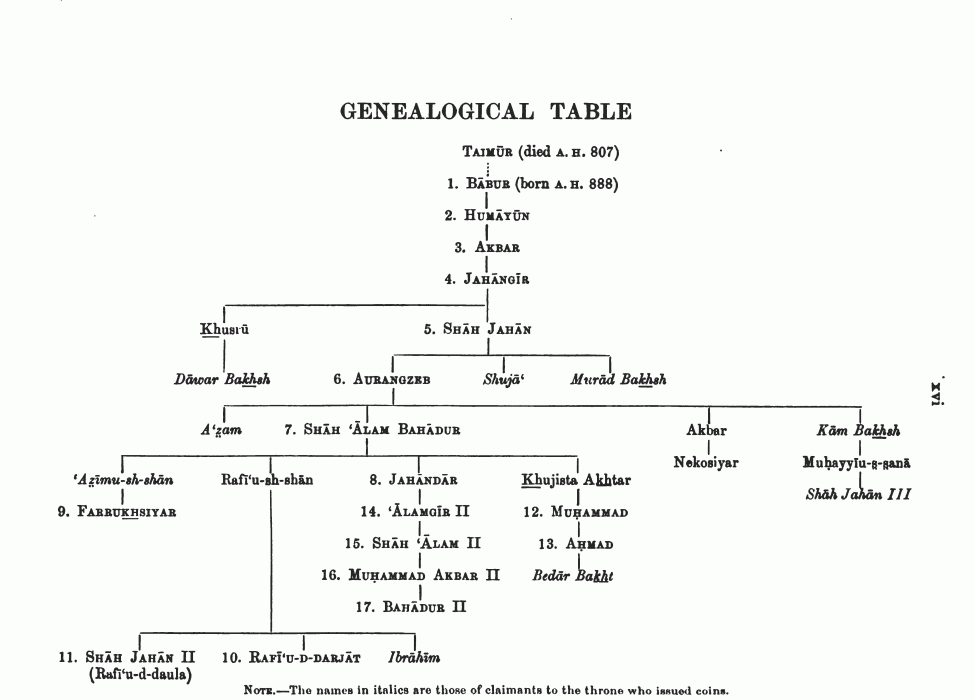
Muslim dynasties were soon established and subsequent empires such as those of the
Abbasids,
Almoravids,
Seljuk Turks,
Mughals in India and
Safavids in
Persia and
Ottomans were among the largest and most powerful in the world. The Islamic world was composed of numerous sophisticated centers of culture and science with far-reaching mercantile networks, travelers, scientists, astronomers, mathematicians, doctors and
philosophers, all of whom contributed to the
Golden Age of Islam.
The activities of this quasi-political early
ummah resulted in the spread of Islam as far from
Mecca as
China and
Indonesia, the latter containing the world's largest Muslim population. As of October 2009, there were 1.571 billion Muslims,
[1] making Islam the
second-largest religion in the world.
[2]
Conversion
Increasing
conversion to Islam paralleled the rapid growth of the
Arab Empire in the first centuries after the Islamic prophet
Muhammad's death. Muslim dynasties were soon established in
North Africa,
West Africa, throughout the
Middle East and in
Iran. It is generally agreed upon by historians that this took place through conversion of slaves and poor people, as well as waging wars on nearby tribes.
Phase I: The Early Caliphs and Umayyads (610-750)
This was the time of the life of Islamic Prophet Muhammad and his early successors, the four
rightly guided caliphs, as well as the dynasty of the
Umayyad Caliphs (661-750).
In the first century the establishment of Islam upon the
Arabian peninsula and the subsequent rapid expansion of the
Arab Empire during the
Muslim conquests, resulted in the formation of an empire surpassed by none before.
[3] For the subjects of this new empire, formerly subjects of the greatly reduced
Byzantine, and obliterated
Sassanid, Empires, not much changed in practice. The objective of the conquests was more than anything of a practical nature, as fertile land and water were scarce in the Arabian peninsula. A real Islamization therefore only came about in the subsequent centuries.
[4]
Ira Lapidus distinguishes between two separate strands of converts of the time: one is animists and polytheists of tribal societies of the Arabian peninsula and the
Fertile crescent; the other one is the monotheistic populations of the Middle Eastern agrarian and urbanized societies.
[5]
For the polytheistic and pagan societies, apart from the religious and spiritual reasons each individual may have had, conversion to Islam "represented the response of a tribal, pastoral population to the need for a larger framework for political and economic integration, a more stable state, and a more imaginative and encompassing moral vision to cope with the problems of a tumultuous society."
[5] In contrast, for sedentary and often already monotheistic societies, "Islam was substituted for a Byzantine or Sassanian political identity and for a Christian, Jewish or Zoroastrian religious affiliation."
[5] Conversion initially was neither required nor necessarily wished for: "(The Arab conquerors) did not require the conversion as much as the subordination of non-Muslim peoples. At the outset, they were hostile to conversions because new Muslims diluted the economic and status advantages of the Arabs."
[5]
Only in subsequent centuries, with the development of the religious doctrine of Islam and with that the understanding of the Muslim
ummah, did mass conversion take place. The new understanding by the religious and political leadership in many cases led to a weakening or breakdown of the social and religious structures of parallel religious communities such as Christians and Jews.
[5]
The calipha of the Umayyad dynasty established the first schools inside the empire, called
madrasas, which taught the Arabic language and Islamic studies. They furthermore began the ambitious project of building mosques across the empire, many of which remain today as the most magnificent mosques in the Islamic world, such as the Umayyad Mosque in Damascus. At the end of the Umayyad period, less than 10% of the people in Iran, Iraq, Syria, Egypt, Tunisia and Spain were Muslim. Only on the Arabian peninsula was the proportion of Muslims among the population even higher than this.
[6]
[edit] Phase II: The Abbasids (750-1258)
This was the time of the
Abbasid Dynasty (750-1258), the second great dynasty with the rulers carrying the title of 'Caliph'.
Expansion ceased and the central disciplines of Islamic
philosophy,
theology,
law and
mysticism became more widespread and the gradual conversions of the populations within the empire occurred. Significant conversions also occurred beyond the extents of the empire such as that of the
Turkic tribes in
Central Asia and peoples living in regions south of the
Sahara in
Africa through contact with Muslim traders active in the area and
sufi missionaries. In Africa it spread along three routes, across the Sahara via trading towns such as
Timbuktu, up the
Nile Valley through
the Sudan up to
Uganda and across the
Red Sea and down
East Africa through settlements such as
Mombasa and
Zanzibar. These initial conversions were of a flexible nature and only later were the societies forcibly purged of their traditional influences.
[3]
The reasons why, by the end of the 10th century CE, a large part of the population had converted to Islam are diverse. One of the reasons may be that
"Islam had become more clearly defined, and the line between Muslims and non-Muslims more sharply drawn. Muslims now lived within an elaborated system of ritual, doctrine and law clearly different from those of non-Muslims. (...) The status of Christians, Jews and Zoroastrians was more precisely defined, and in some ways it was inferior. They were regarded as the 'People of the Book', those who possessed a revealed scripture, or 'People of the Covenant', with whom compacts of protection had been made. In general they were not forced to convert, but they suffered from restrictions. They paid a special tax; they were not supposed to wear certain colors; they could not marry Muslim women;."[6]
It should be pointed out that most of these laws were elaborations of basic laws concerning non-Muslims (
dhimmis) in the
Quran. The Quran does not give much detail about the right conduct with non-Muslims, in principle recognizing the religions of the book and demanding a separate tax for them.
American historian
Ira Lapidus points towards "interwoven terms of political and economic benefits and of a sophisticated culture and religion" as appealing to the masses.
[7] He writes that :
"The question of why people convert to Islam has always generated intense feeling. Earlier generations of European scholars believed that conversions to Islam were made at the point of the sword, and that conquered peoples were given the choice of conversion or death. It is now apparent that conversion by force, while not unknown in Muslim countries, was, in fact, rare. Muslim conquerors ordinarily wished to dominate rather than convert, and most conversions to Islam were voluntary. (...) In most cases worldly and spiritual motives for conversion blended together. Moreover, conversion to Islam did not necessarily imply a complete turning from an old to a totally new life. While it entailed the acceptance of new religious beliefs and membership in a new religious community, most converts retained a deep attachment to the cultures and communities from which they came."[7]
The result of this, he points out, can be seen in the diversity of Muslim societies today, with varying manifestations and practices of Islam.
Conversion to Islam also came about as a result of the breakdown of historically religiously organized societies: with the weakening of many churches, for example, and the favoring of Islam and the migration of substantial Muslim Turkish populations into the areas of Anatolia and the Balkans, the "social and cultural relevance of Islam" were enhanced and a large number of peoples were converted. This worked better in some areas (Anatolia) and less in others (e.g. the Balkans, where "the spread of Islam was limited by the vitality of the Christian churches.")
[5]
Along with the religion of Islam, the Arabic language and Arab customs spread throughout the empire. A sense of unity grew among many though not all provinces, gradually forming the consciousness of a broadly Arab-Islamic population: something which was recognizably an Islamic world had emerged by the end of the 10th century.
[8] Throughout this period, as well as in the following centuries, divisions occurred between Persians and Arabs, and Sunnis and Shiites, and unrest in provinces empowered local rulers at times.
[6]
Conversion within the Empire: Umayyad Period vs. Abassid Period
There are a number of historians who see the rule of the Umayyads as responsible for setting up the "dhimmah" to increase taxes from the
dhimmis to benefit the Arab Muslim community financially and to discourage conversion.
[9] Islam was initially associated with the ethnic identity of the Arabs and required formal association with an Arab tribe and the adoption of the client status of
mawali.
[9] Governors lodged complaints with the caliph when he enacted laws that made conversion easier, depriving the provinces of revenues.
During the following
Abbasid period an enfranchisement was experienced by the
mawali and a shift was made in the political conception from that of a primarily Arab empire to one of a Muslim empire
[10] and c. 930 a law was enacted that required all bureaucrats of the empire to be Muslims.
[9] Both periods were also marked by significant migrations of Arab tribes outwards from the
Arabian Peninsula into the new territories.
[10]
Conversion within the Empire: Conversion Curve
Richard Bulliet's "conversion curve" shows a relatively low rate of conversion of non-Arab subjects during the Arab centric
Umayyad period of 10%, in contrast with estimates for the more politically multicultural
Abbasid period which saw the Muslim population grow from approx. 40% in the mid 9th century to close to 100% by the end of the 11th century.
[10] This theory does not explain the continuing existence of large minorities of Christians in the Abbasid Period. Other estimates suggest that Muslims were not a majority in Egypt until the mid-10th century and in the Fertile Crescent until 1100. Syria may have had a Christian majority within its modern borders until the Mongol Invasions of the 13th century.
[edit] Phase III: Dissolution of the Abbasid Empire and its Reconquest by the Ottomans (950-1450)
The expansion of Islam continued in the wake of
Turkic conquests of
Asia Minor, the
Balkans, and the
Indian subcontinent.
[3] The earlier period also saw the acceleration in the rate of conversions in the Muslim heartland while in the wake of the conquests the newly conquered regions retained significant non-Muslim populations in contrast to the regions where the boundaries of the Muslim world contracted, such as
Sicily and
Al Andalus, where Muslim populations were expelled or forced to
Christianize in short order.
[3] The latter period of this phase was marked by the
Mongol invasion (particularly the
sack of Baghdad in 1258]]) and after an initial period of persecution, the conversion of these conquerors to Islam.
[edit] Phase IV: Ottoman Empire: 13th Century - 1918
The
Ottoman Empire defended its frontiers initially against threats from several sides: the
Safavids on the Eastern side, the
Byzantine Empire in the North which vanished with the fall of Constantinople 1453, and the great Catholic powers from the Mediterranean Sea: Spain, the Holy Roman Empire, and Venice with its eastern Mediterranean colonies.
Later, the Ottoman Empire set on to conquer territories from these rivals: Cyprus and other Greek islands (except Crete) were lost by Venice to the Ottomans, and the latter conquered territory up to the Danube basin as far as Hungary. Crete was conquered during the 17th century, but the Ottomans lost Hungary to the Holy Roman Empire, and other parts of Eastern Europe, ending with the
Treaty of Carlowitz (1699).
[11]
Phase V: (Post-Ottomans - present)
Islam has continued to spread through commerce, the activities of
Sufi missionaries, and migrations; especially in
Southeast Asia.
[3]
By region
Arabia
At
Medina, prophet
Muhammad is said to have received repeated embassies from Christian tribes.
Soon after the death of prophet
Muhammad, all these provinces fell, one after the other, into the hands of the Muslims, who threatened, for a while, the entire extinction of Christianity in
Western Asia. Due however to the tolerant attitude of the majority of the
Umayyad, and the
Abbasid caliphs of
Damascus and
Baghdad respectively, Christianity in the Muslim empire gradually began to experience a new and unprecedented level of revival and vigour.
Nestorian and
Jacobite theologians, philosophers, and men of letters soon became the teachers of the conquering Arabs, and the pioneers of Islamo-Arabic science, civilization, and learning. Nestorian physicians became the attending physicians of the court, and the Nestorian patriarch and his numerous bishops were regarded in Asia as second to none in power and authority.
Under the Umayyad and Abbasid Caliphs, Christianity enjoyed, with few exceptions, great freedom and respect throughout all the Muslim Empire, as can be seen from the facts and data collected by
Assemani and
Bar-Hebraeus, according to which many Nestorian and Jacobite patriarchs from the seventh to the eleventh centuries received diplomas, or firmans, of some sort from prophet
Muhammad himself, from
Umar,
Ali,
Marwan,
Al-Mansur,
Harun al-Rashid,
Abu Ja'far, and others. (Shedd, op. cit., 239-241; Assemani, De Catholicis Nestorianis, 41-433 sqq.; Bar-Hebraeus, Chronicon Ecclesiasticum I, 309, 317, 319, 325; II, 465, 625; III, 307, 317, 229, 433, etc.; and Thomas of Marga, op. cit., II, 123, note:)
[edit] Greater Syria
In
635 Damascus surrendered, its inhabitants being promised security for their lives, property, and churches, on payment of a
poll tax, for which the actual arabic name that convery the true practise is Jizay جزية
[1]. By
640 the conquest was virtually complete. The Arab garrisons were kept apart in camps, and life went on much as before. Conversion to Islam had scarcely begun, apart from Arab tribes already settled in Syria; except for the tribe of
Ghassan, these all became Muslim. Christians and Jews were treated with toleration, and
Nestorian and
Jacobite Christians had better treatment than they had under
Byzantium[12] . The loyalty of his new subjects was paramount to the success of Muslim rule in the region, therefore excessive taxation or oppression was avoided.
[13]
Like their Byzantine and late Sasanian predecessors, the
Marwanid caliphs nominally ruled the various religious communities but allowed the communities' own appointed or elected officials to administer most internal affairs. Yet the Marwanids also depended heavily on the help of non-Arab administrative personnel and on administrative practices (e.g., a set of government bureaus). As the conquests slowed and the isolation of the fighters (
muqatilah) became less necessary, it became more and more difficult to keep Arabs garrisoned. As the tribal links that had so dominated Umayyad politics began to break down, the meaningfulness of tying non-Arab converts to Arab tribes as clients was diluted; moreover, the number of non-Muslims who wished to join the ummah was already becoming too large for this process to work effectively.
[14]
[edit] Palestine
The Muslims arrived at Jerusalem around early November
636, and the Roman garrison withdrew into the fortified city. For four months the siege continued, every day there was a fierce assault. At last, when all further resistance was hopeless, the
Patriarch Patriarch Sophronius (who acted throughout as the head of the Christian defenders) appeared on the walls and demanded a conference with
Abu Ubaidah. He then proposed to capitulate on fair and honorable terms; the Christians were to keep their churches and sanctuaries, no one was to be forced to accept Islam.
Sophronius further insisted that these terms should be ratified by the caliph in person.
Caliph Umar, then at Medina, agreed to these terms and came with a single camel to the walls of
Jerusalem. He signed the capitulation, then entered the city with Sophronius "and courteously discoursed with the patriarch concerning its religious antiquities".
[15]
It is said that when the hour for his prayer came he was in the Anastasis, but refused to say it there, lest in future times the Muslims should make that an excuse for breaking the treaty and confiscating the church. The Mosque of Omar (Jami 'Saidna 'Omar), opposite the doors of the Anastasis, with the tall minaret, is shown as the place to which he retired for his prayer. Under the Muslim the Christian population of Jerusalem in the first period enjoyed the usual toleration given to non-Muslim theists. The pilgrimages went on as before .
[16] From that point, the rights of the non-Muslims under Islamic territory were governed by the
Pact of Umar, and Christians and Jews living in the city were granted autonomy in exchange for a required
poll tax (
jizya) .
[17]
The description of Arculf, a Frankish bishop who went on a pilgrimage to the Holy Land in the seventh century, written down from his account by Adamnan, monk of Iona (d. 704): "De locis terrae sanctae", lib. III (P. L., LXXXVIIl, 725 sq.), gives us a pleasant picture of the conditions of Christians in Palestine in the first period of Muslim rule. The caliphs of Damascus (661-75O) were enlightened and tolerant princes, on quite good terms with their Christian subjects. Many Christians (e.g. St. John Damascene, d. c. 754) held important offices at their court. The Abbaside caliphs at Baghdad (753-1242), as long as they ruled Syria, were also just and tolerant to the Christians. The famous Harun Abu-Ja-'afar (
Haroun al-Raschid, 786-809) sent the keys of the
Holy Sepulchre to Charlemagne who built a hospice for Latin pilgrims near the shrine.
[16]
During the Fatimid rule, Romans were attacking Syria. It was inevitable that the Christians of Jerusalem should try to help their fellow-countrymen to reconquer the land that had been Roman and Christian; inevitable, too, that the Muslims should punish such attempts as high treason. In
969 the patriarch, John VII, was put to death for treasonable correspondence with the Romans; many other Christians suffered the same fate, and a number of churches were destroyed. The infamous
Hakim (Al-Hakim bi-amr-Allah, the sixth Egyptian Caliph, 996-1021, who became the god of the
Druze) determined to destroy the Holy Sepulcher (In 1010). It was one of the causes of the feeling that eventually brought about the
First Crusade. It was rebuilt in
1048.
[16]
The caliphs go in the order of
Abu Bakr, then Umar, followed by Uthman, and Ali then his son Hassan, before the Sunni Shia split. In 635 Damascus surrendered, its inhabitants being promised security for their lives, property, and churches, on payment of a poll tax. by 640 the conquest was virtually complete. The Arab garrisons were kept apart in camps, and life went on much as before.
Conversion to Islam had scarcely begun, apart from Arab tribes already settled in Syria; except for the tribe of Ghassan, these all became Muslim. Christians and Jews were treated with toleration, and Nestorian and Jacobite Christians had better treatment than they had under Byzantium[3] . The loyalty of his new subjects was paramount to the success of Muslim rule in the region, therefore excessive taxation or oppression was avoided[4]
[edit] Iraq, Persia, and Central Asia
It used to be argued that
Zoroastrianism quickly collapsed in the wake of the
Islamic conquest of Persia due to its intimate ties to the
Sassanid state structure.
[18] Now however, more complex processes are considered, in light of the more protracted time frame attributed to the progression of the ancient Persian religion to a minority; a progression that is more contiguous with the trends of the
late antiquity period.
[18] These trends are the conversions from the state religion that had already plagued the Zoroastrian authorities that continued after the Arab conquest, coupled with the migration of Arab tribes into the region during an extended period of time that stretched well into the Abbassid reign.
[18]
While there were cases such as the Sassanid army division at Hamra, that converted
en masse before pivotal battles such as the
Battle of al-Qādisiyyah, conversion was fastest in the
urban areas where Arab forces were
garrisoned slowly leading to Zoroastrianism becoming associated with
rural areas.
[18] Still at the end of the Umayyad period, the Muslim community was only a minority in the region.
[18]
[edit] Turkey
[edit] Indian sub-continent
Islamic influence first came to be felt in the
Indian subcontinent during the early 7th century with the advent of Arab traders. Arab traders used to visit the
Malabar region, which was a link between them and the ports of
South East Asia to trade even before Islam had been established in Arabia. According to Historians Elliot and Dowson in their book
The History of India as told by its own Historians, the first ship bearing Muslim travelers was seen on the Indian coast as early as
630 AD.
H.G. Rawlinson, in his book:
Ancient and Medieval History of India[19] claims the first Arab Muslims settled on the Indian coast in the last part of the 7th century AD. This fact is corroborated, by J. Sturrock in his
South Kanara and Madras Districts Manuals,
[20] and also by Haridas Bhattacharya in
Cultural Heritage of India Vol. IV.
[21] The Arab merchants and traders became the carriers of the new religion and they propagated it wherever they went.
[22] It was however the subsequent expansion of the
Muslim conquest in the Indian subcontinent over the next millennia that established Islam in the region.
Considerable controversy exists both in scholarly and public opinion about the conversions to Islam. Some Indian historians, such as
K.S. Lal, suggest that some 80 million
Hindus could have been killed over the centuries, through the Islamic conquest of the
Indian subcontinent. Embedded within this lies the concept of Islam as a foreign imposition and
Hinduism being a natural condition of the natives who resisted, resulting the failure of the project to Islamicize the Indian subcontinent and is highly embroiled with the politics of the
partition and
communalism in India.
[23] These are typically represented by the following schools of thought:
[23]
- That the bulk of Muslims are descendants of migrants from the Iranian plateau or Arabs.[24]
- That Muslims sought conversion through jihad or political violence[23]
- A related view is that conversions occurred for non-religious reasons of pragmatism and patronage such as social mobility among the Muslim ruling elite or for relief from taxes[23][24]
- Conversion was a result of the actions of Sufi saints and involved a genuine change of heart[23]
- Conversion came from Buddhists and the en masse conversions of lower castes for social liberation and as a rejection of oppressive existent Hindu caste strictures.[24]
- Was a combination, initially made under duress followed by a genuine change of heart[23]
- As a socio-cultural process of diffusion and integration over an extended period of time into the sphere of the dominant Muslim civilization and global polity at large.[24]
[edit] Southeast Asia
Islam came to the
Southeast Asia, first by the way of Muslim traders along the main trade-route between Asia and the
Far East, then was further spread by Sufi missionaries and finally consolidated by the expansion of the territories of converted rulers and their communities.
[25] The first communities arose in Northern
Sumatra (
Aceh) and the
Malacca's remained a stronghold of Islam from where it was propagated along the trade routes in the region.
[25] There is no clear indication of when Islam first came to the region, the first Muslim gravestone markings date to 1082.
[26]
When
Marco Polo visited the area in 1292 he noted that the urban port state of
Perlak was Muslim,
[26] Chinese sources record the presence of a Muslim delegation to the emperor from the
Kingdom of Samudra (Pasai) in 1282,
[25] other accounts provide instances of Muslim communities present in the
Melayu Kingdom for the same time period while others record the presence of Muslim Chinese traders from provinces such as
Fujian.
[26] The spread of Islam generally followed the trade routes east through the primarily
Buddhist region and a half century later in the
Malacca's we see the first dynasty arise in the form of the
Sultanate of Malacca at the far end of the Archipelago form by the conversion of one
Parameswara Dewa Shah into a Muslim and the adoption of the name Muhammad Iskandar Shah
[27] after his marriage to a daughter of the ruler of Pasai.
[25][26]
In 1380 Sufi missionaries carried Islam from here on to
Mindanao.
[28] Java was the seat of the primary kingdom of the region, the
Majapahit Empire, which was ruled by a
Hindu dynasty. As commerce grew in the region with the rest of the Muslim world, Islamic influence extended to the court even as the empires political power waned and so by the time
Raja Kertawijaya converted in 1475 at the hands of Sufi
Sheikh Rahmat, the Sultanate was already of a Muslim character.
Another driving force for the change of the ruling class in the region was the concept among the increasing Muslim communities of the region that only the descendants of the Islamic
prophet Muhammad (
Sayyid) were fit to rule them causing the ruling dynasties to attempt to forge such ties of kinship by marriage.
[28] By the time the
colonial powers and their
missionaries arrived in the 17th century the region up to
New Guinea was overwhelmingly Muslim with
animist minorities.
[26]
[edit] Inner Asia and Eastern Europe
Little is known about the timeline of the Islamization of
Inner Asia and the
Turkic peoples who lay beyond the bounds of the
caliphate. Around 600s and 700s, there were some states of Turkic peoples like
Turkic Khazar Khaganate (See
Khazar-Arab Wars) and
Turkic Turgesh Khaganete who fought against the caliphate in order to stop
Arabization and
Islamization in Asia. From the ninth century onwards, the Turks (at least individually, if not yet through adoption by their states) began to convert to Islam. Histories merely note the fact of pre-
Mongol Central Asia's Islamization.
[29] The
Bulgars of the Volga are noted to have adopted Islam by the 10th century
[29] under
Almış, to whom the modern
Volga Tatars trace their Islamic roots. When the
Friar William of Rubruck visited the encampment of
Batu Khan of the
Golden Horde, who had recently completed the
Mongol invasion of Volga Bulgaria, he noted "I wonder what devil carried the law of Machomet there".
[29]
Another contemporary known to have been Muslim, was the
Qarakhanid dynasty of the
Kara-Khanid Khanate which lay much further east
[29], and which was established by
Karluks who were Islamizated Islam after
Battle of Talas. However, the modern day history of the Islamization of the region - or rather a conscious affiliation with Islam - dates to the reign of the
ulus of the son of
Genghis Khan,
Jochi, who founded the Golden Horde.
[30] Kazakhs,
Uzbeks and some Muslim populations of the
Russian Federation trace their Islamic roots to the Golden Horde
[29] and while
Berke Khan was the first Mongol monarch to officially adopt Islam and even oppose his kinsman
Hulagu Khan[29] in the defense of
Jerusalem at the
Battle of Ain Jalut, it was only much later that the change became pivotal and the Mongols converted
en masse[31] when a century later
Uzbeg Khan converted - reportedly at the hands of the
Sufi Saint Baba Tukles.
[32]
Some of the Mongolian tribes became Islamized. Following the brutal
Mongol invasion of Central Asia under
Hulagu Khan and after the
Battle of Baghdad (1258) Mongol rule extended across the breadth of almost all Muslim lands in
Asia,and the caliphate was destroyed and Islam was
persecuted by the Mongols and replaced by
Buddhism as the official religion of the land.
[31] In 1295 however, the new Khan of the
Ilkhanate,
Ghazan converted to Islam and two decades later the Golden Horde followed suit.
[31] The Mongols had been religiously and culturally conquered, this absorption ushered in a new age of Mongol-Islamic synthesis
[31] that shaped the further spread of Islam in central Asia and the
Indian subcontinent.
In the 1330s the Mongol ruler of the
Chagatai Khanate converted to Islam, causing the eastern part of his realm called
Moghulistan to rebel.
[33] However during the next three centuries these
Buddhist,
Shamanistic and
Christian Turkic and Mongol nomads of the
Kazakh Steppe and
Xinjiang would also convert at the hands of competing
Sufi orders from both east and west of the
Pamirs.
[33] The
Naqshbandi's are the most prominent of these orders, especially in
Kashgaria where the western Chagatai Khan was also a disciple of the order.
[33]
[edit] Africa
[edit] North Africa
- See also: Umayyad conquest of North Africa, Islamization of Egypt, Islamization of Sudan
In
Egypt, the victorious Muslims granted religious freedom to the Christian community in
Alexandria, for example, and the Alexandrians quickly recalled their exiled
Monophysite patriarch to rule over them, subject only to the ultimate political authority of the conquerors. In such a fashion the city persisted as a religious community under an Arab Muslim domination more welcome and more tolerant than that of Byzantium .
[34]
Byzantine rule was ended by the Arabs, who invaded
Morocco in
682 in the course of their drive to expand the power of Islam.
Berber troops were used extensively by the Arabs in their conquest of Spain, which began in
711.
[35]
No previous conqueror had tried to assimilate the Berbers, but the Arabs quickly converted them and enlisted their aid in further conquests. Without their help, for example, Andalusia could never have been incorporated into the Islamicate state. At first only Berbers nearer the coast were involved, but by the 11th century Muslim affiliation had begun to spread far into the
Sahara.
[36]
The conventional historical view is that the conquest of North Africa by the Islamic Umayyad Caliphate between AD 647–709 effectively ended Catholicism in Africa for several centuries.
[37] However, new scholarship has appeared that provides more nuance and details of the conversion of the Christian inhabitants to Islam. A Christian community is recorded in 1114 in Qal'a in central Algeria. There is also evidence of religious pilgrimages after 850 AD to tombs of Catholic saints outside of the city of Carthage, and evidence of religious contacts with Christians of Arab Spain. In addition, calendar reforms adopted in Europe at this time were disseminated amongst the indigenous Christians of Tunis, which would have not been possible had there been an absence of contact with Rome.
[edit] Horn of Africa
- See also: Islam in Somalia, Islam in Ethiopia
The history of commercial and intellectual contact between the inhabitants of the Somali coast and the
Arabian Peninsula may help explain the Somali people's connection with the Prophet
Muhammad. Early on, a band of persecuted
Muslims had, at the Prophet's urging, fled across the
Red Sea into the
Horn of Africa. There, the Muslims were granted protection by the Ethiopian
negus (king).
Islam may thus have been introduced into the Horn of Africa well before the faith even took root in its place of origin.
[38]
[edit] East Africa
On the east coast of Africa, where Arab mariners had for many years journeyed to trade, Arabs founded permanent colonies on the offshore islands, especially on
Zanzibar, in the 9th and 10th century. From there Arab trade routes into the interior of Africa helped the slow acceptance of Islam. In the 20th cent. Islam has gained more converts in Africa than has Christianity, which labors under the burden of identification with European
imperialism.
[39]
[edit] Western Africa
The spread of Islam in Africa began in the 7th to 9th century CE, brought to North Africa initially under the
Umayyad Dynasty. Extensive trade networks throughout North and West Africa created a medium through which Islam spread peacefully, initially through the merchant class. By sharing a common religion and a common transliteralization (
Arabic), traders showed greater willingness to trust, and therefore invest, in one another.
[40]
[edit] Europe
[edit] Hispania /Al-Andalus
The history of Arab and Islamic rule in the Iberian peninsula is probably one of the most studied periods of European history, but the variety and quantity of writing has not escaped the prejudices of the authors. For centuries after the Arab conquest, European accounts of Arab rule in Iberia were negative, reflecting Christian insecurities generated by the wave of Arab victories. European points of view started changing with the Protestant Reformation, which resulted in new descriptions of the period of Islamic rule in Spain as a "golden age" (mostly as a reaction against Spain's militant Roman Catholicism after 1500).
The tide of Arab expansion after 630 rolled through North Africa up to Ceuta in present day Morocco. Their arrival coincided with a period of political weakness in the three centuries old kingdom established in the Iberian peninsula by the Germanic Visigoths, who had taken over the region after seven centuries of Roman rule. Seizing the opportunity, an Arab-led (but mostly Berber) army invaded in 711, and by 720 had conquered almost all of the peninsula. The Arab expansion pushed over the mountains into southern France, and for a short period Arabs controlled the old Visigothic province of Septimania (centered on present-day Narbonne). The Arab Caliphate was pushed back by Charles Martel (King of the Franks or French) at Poitiers, and Christian armies started pushing southwards over the mountains, until Charlemagne established in 801 the Spanish March (which stretched from Barcelona to present day Navarre).
A major development in the history of Muslim Spain was the dynastic change in 750 in the Arab Caliphate, when an Ummayad Prince escaped the slaughter of his family in Damascus, fled to Cordoba in Spain, and created a new Islamic state in the area. This was the start of a distinctly Spanish Muslim society, where large Christian and Jewish populations coexisted with an increasing percentage of Muslims. There are many stories of descendants of Visigothic chieftains and Roman counts whose families converted to Islam during this period. The at-first small Muslim elite continued to grow with converts, and with a few exceptions, rulers in Islamic Spain allowed Christians and Jews the right specified in the Koran to practice their own religions. While it was true that non Muslims suffered from political and taxation inequities, the Jewish and Christian people where allowed to practice their religions and culture. The net result was, in those areas of Spain where Muslim rule lasted the longest, the creation of a society that was mostly Arabic-speaking because of the assimilation of native inhabitants, a process in some ways similar to the assimilation many years later of millions of immigrants to the United States into English-speaking culture.
The Islamic state centered in Cordoba ended up splintering into many smaller kingdoms (the so-called taifas). While Muslim Spain was fragmenting, the Christian kingdoms grew larger and stronger, and the balance of power shifted against the taifa kingdoms. The last Muslim kingdom of Granada in the south fell to Christian conquerors in 1492. In 1499, the remaining Muslim inhabitants were ordered to convert or leave (at the same time the Jews were expelled). Poorer Muslims (
Moriscos) who could not afford to leave ended up converting to Catholic Christianity and hiding their Muslim practices, hiding from the Spanish Inquisition, until their presence was finally extinguished.
Balkans
In Balkan history, writing the question of conversion to Islam was, and still is, a highly charged political issue. It is intrinsically linked to the issues of formation of national identities and rival territorial claims of the Balkan states. The generally accepted nationalist discourse of the current Balkan historiography defines all forms of Islamization as results of the Ottoman government's centrally organized policy of conversion or
dawah. The truth is that Islamization in each Balkan country took place in the course of many centuries, and its nature and phase was determined not by the Ottoman government but by the specific conditions of each locality. Ottoman conquests were initially military and economic enterprises, and religious conversions were not the their primary objective. True, the statements surrounding victories all celebrated the incorporation of territory into Muslim domains, but the actual Ottoman focus was on taxation and making the realms productive, and a religious campaign would have disrupted that economic objective.
Ottoman Islamic standards of toleration allowed for autonomous "nations" (
millets) in the Empire, under their own personal law and under the rule of their own religious leaders. As a result, vast areas of the Balkans remained mostly Christian during the period of Ottoman domination. In fact, the Eastern Orthodox Churches had a higher position in Ottoman Empire, mainly because the Patriarch resided in Istanbul and was an officer of the Ottoman Empire. In contrast, Roman Catholics, while tolerated, were suspected with loyalties to a foreign power (the Papacy). It is no surprise that the Roman Catholic areas of Bosnia, Kosovo and northern Albania, ended up with more substantial conversions to Islam. The defeat of the Ottomans in 1699 by the Austrians resulted in their loss of Hungary and present-day Croatia. The remaining Muslim converts in both elected to leave "lands of unbelief" and moved to territory still under the Ottomans. Around this point in time, new European ideas of romantic nationalism started to seep into the Empire, and provided the intellectual foundation for new nationalistic ideologies and the reinforcement of the self-image of many Christian groups as subjugated peoples.
One by one, the Balkan nationalities asserted their independence from the Empire, and frequently the presence of members of the same ethnicity who had converted to Islam presented a problem from the point of view of the now dominant new national ideology, which narrowly defined the nation as members of the local dominant Orthodox Christian denomination. Thousand of Muslims chose to leave, and in some cases were expelled, to what was left of the Ottoman Empire. This demographic transition can be illustrated by the decrease in the number of Mosques in
Belgrade, from over 70 in 1750 (before Serbian independence in 1815), to only three in 1850.
As an example of what most indigenous Muslims endured when the new Christian nation-states emerged in the 19th century, peninsular and Cretan Greeks, who saw themselves as Greek first and spoke the Greek language, eventually were still forced to leave Greece. In the long run, with the exception of Bosnia, Albania, and Kosovo, the vast majority of descendants of Balkan converts to Islam emigrated to Turkey and integrated themselves into Turkish society.
[edit] Eurabia
Eurabia is a political
neologism that refers to the premise that the
Muslim population in Europe will
become a majority within a few generations due to continued
immigration and high
birth rates.
The term was publicized by the writer
Bat Ye'or, especially in her 2005 book
Eurabia: The Euro-Arab Axis, referring to joint Euro-Arab foreign policies that she characterizes as
anti-American and
anti-Zionist.
[41] The term is generally used in combination with "
dhimmitude", another term introduced by Ye'or, denoting an attitude of concession, surrender and
appeasement towards Islam.